
USDJPY joint intervention overview
Read Time: 7-8 minutes
The USDJPY has been receiving a lot of attention in recent months.
The increased attention is not because it’s the second most traded currency pair in the world, and more about a specifically about the phrase ‘intervention’.
In this article, we’ll break down the USDJPY trend, explain FX intervention, discuss the history of intervention, explain why joint intervention is significant and discuss how the recent developments could change the way traders approach the USDJPY pair.
- The recent USDJPY trend
- What is FX intervention?
- History of Japan joint intervention
- First US-Japan joint intervention since 1998
- What did the Fed and BoJ do on 30-31 July 2026?
- Why did the US and Japan intervene?
- Why is joint FX intervention more important?
- How does the joint intervention affect JPY (Yen)?
From 2021 to 2026, the USDJPY has been on a steady grind higher, mainly because interest rates in the US have remained well above those in Japan.
That gap, known as the rate differential, has made the yen a very popular funding currency for carry trades.
This is where traders borrow or sell a currency with a low yield, like the JPY, to buy a currency with a higher yield, like the US Dollar.
The trend in USDJPY has rewarded carry traders as the USDJPY has been grinding higher making them money and also earning them interest at the same time.
By Wednesday 29 July 2026, the USDJPY reached its highest level since 1986.
Then, just two and a half trading days later, the USDJPY pair dropped over 5%.
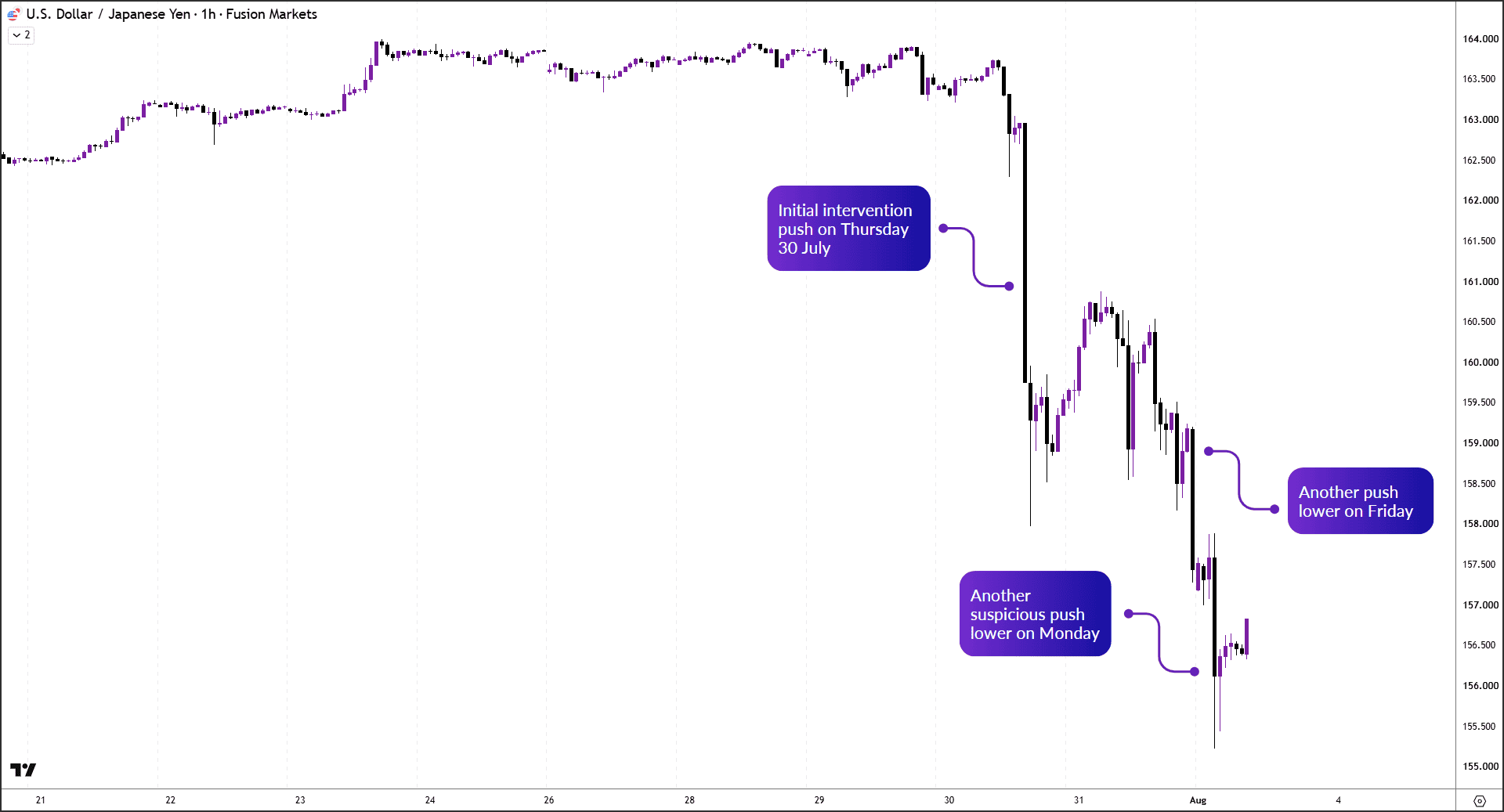
The drop was close to a seven-standard-deviation fall and one of the fastest and most violent reversals the pair has seen in years.
The trigger for the move was joint FX intervention between the US and Japan.
Foreign-exchange or currency intervention is more common than most traders realize.
At its simplest, FX intervention is any direct or indirect attempt by an authority to influence the value of its currency.
Over the past four decades, several central banks and governments have stepped into currency markets for various reasons.
Sometimes the aim is to slow an excessively strong currency that might be hurting exporters or weighing on inflation.
In other cases, the goal is to support a currency that has fallen too far and is pushing up import costs.
Intervention can move markets quickly, but its longer-term impact usually depends on whether the underlying economic reality changes.
It’s important to keep in mind that markets are very used to FX intervention from Japan.
Official data shows us that Japan has intervened in the FX market about 23 times since 1991.
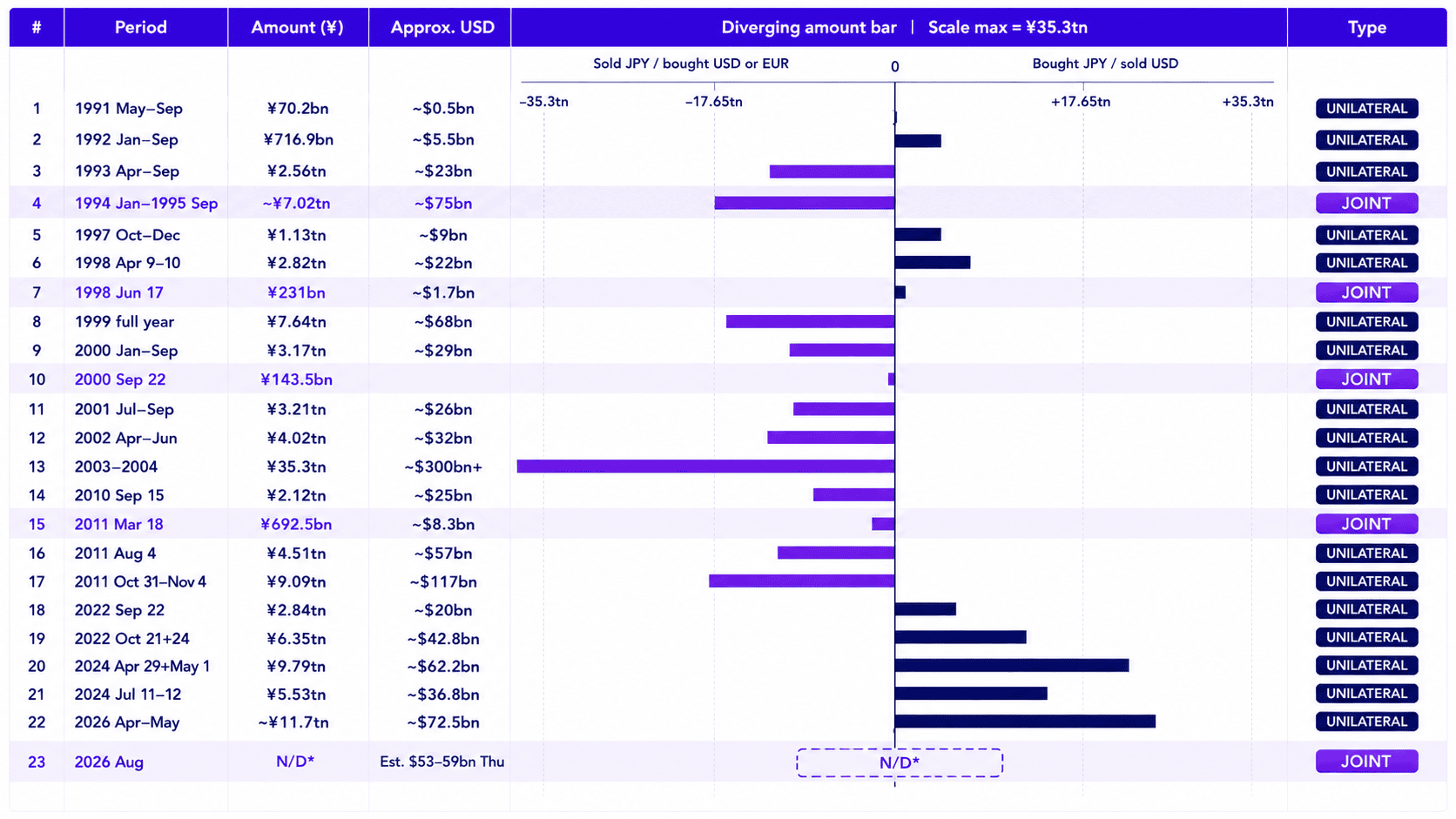
In the case of Japan, the Bank of Japan does the actual intervention, but they do so under guidance from the Finance Ministry.
From the table above, we can see that they have intervened both to weaken and strengthen the Japanese Yen.
We can also notice that most of the intervention was done unilaterally, meaning only by Japan without the involvement of other countries.
Very recently, Japan intervened in April and twice in both 2024 and 2022.
All of these attempts were relatively short-lived affairs.
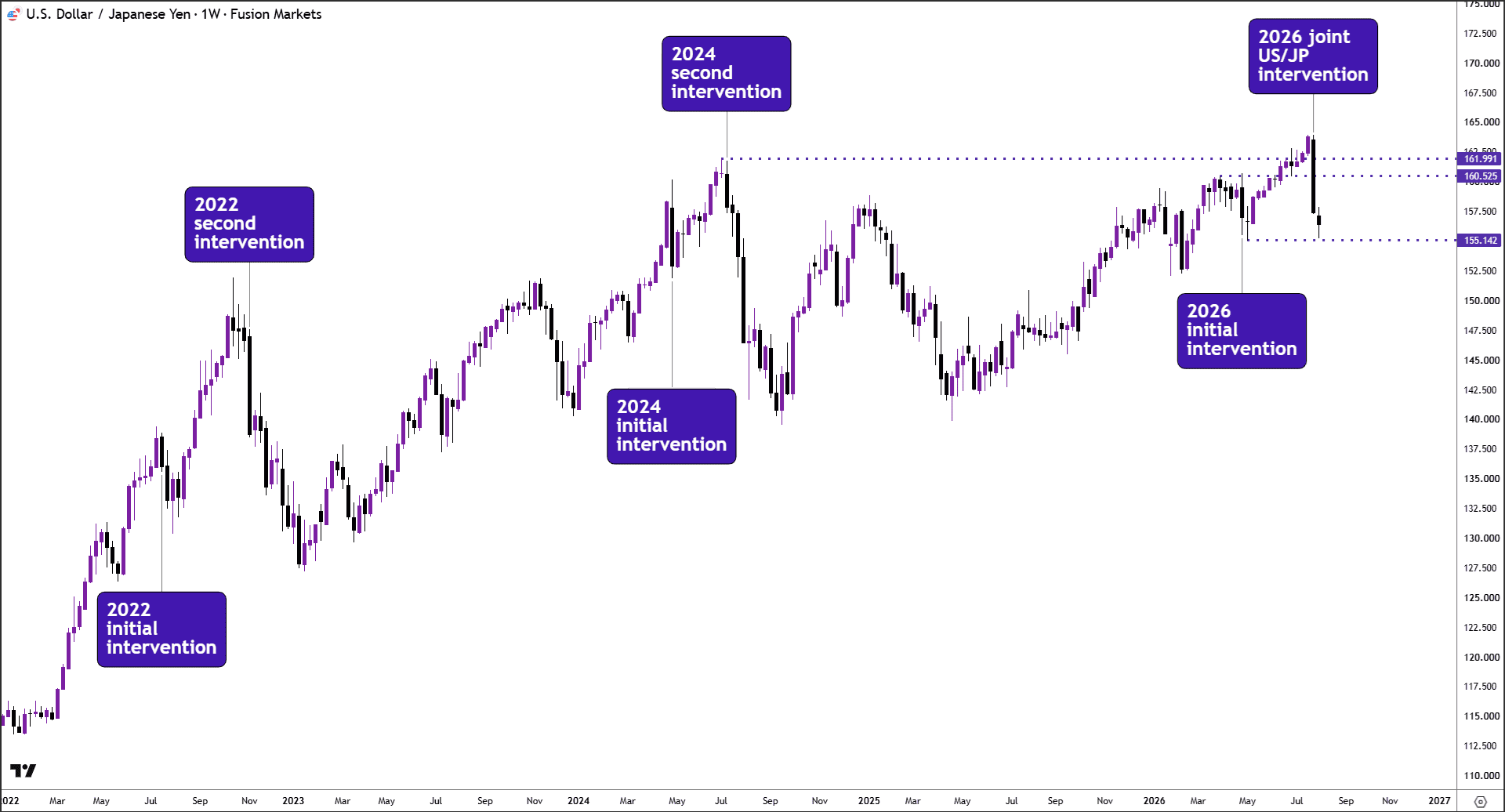
The bullish trend took anything from just a few days to a few weeks to resume.
The reason why previous attempts failed to buckle the trend, is because intervention cannot change fundamentals.
It cannot change the actual reason why the currency has been so weak.
For example, US interest rates remain well above those in Japan, with expectations that the Fed may raise rates sometime in 2026.
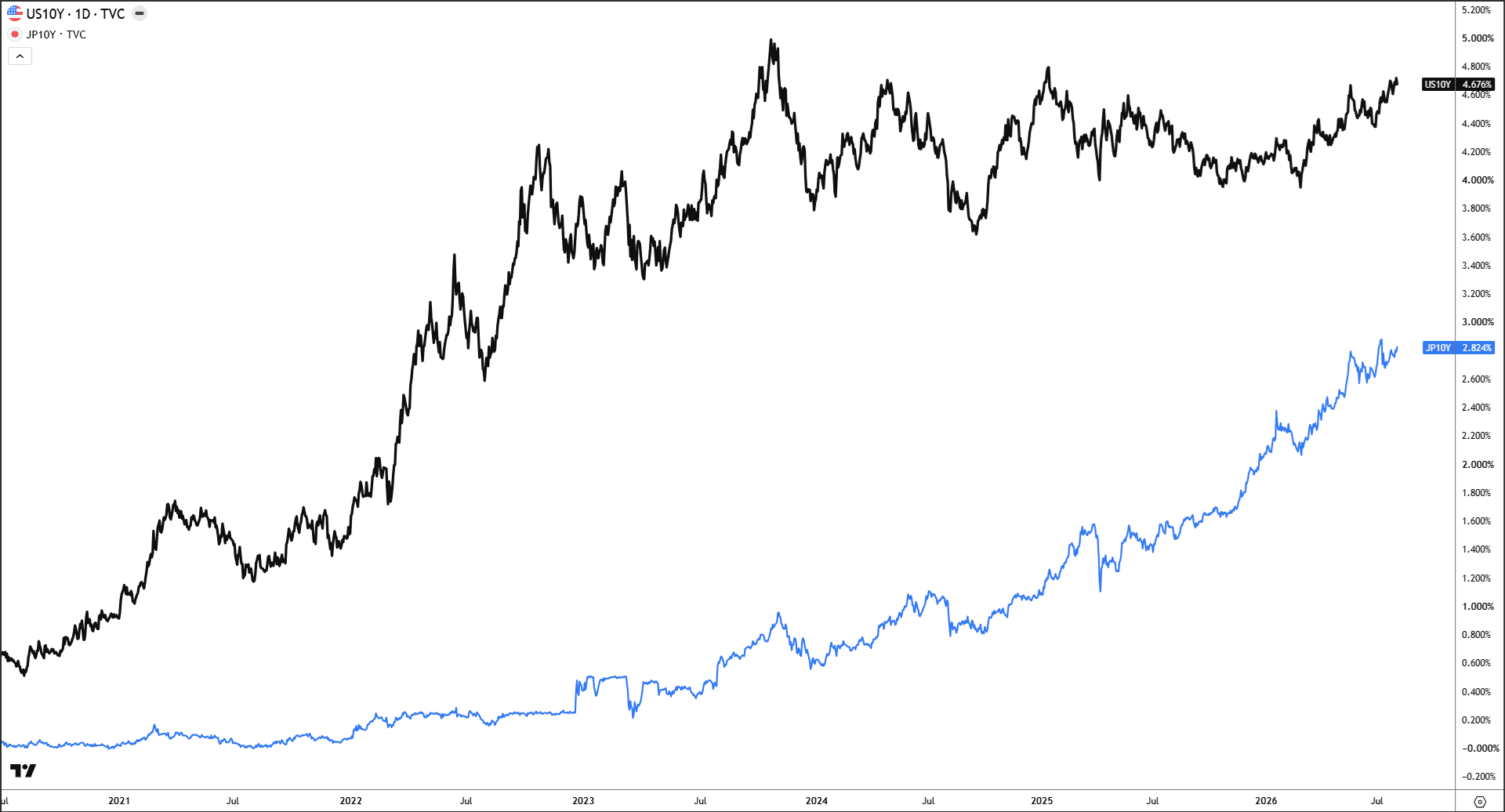
The gap between US and Japanese yields remains very wide.
Despite Japan removing the cap it had in place for years that tried to keep yields in Japan suppressed.
The most recent intervention has unfolded over several stages.
According to reports, Japan first intervened on Thursday 30 July, by buying the yen and selling US Dollars.
Estimates based on Bank of Japan account data suggest that Tokyo spent around ¥8.45 trillion, or about $53 billion.
Now, it appears they continued their operation on Friday, but what made Friday different was that the New York Fed reportedly sold euros to buy the yen on behalf of the Treasury.
This was a stark contrast to the types of interventions markets have been used for in recent years.
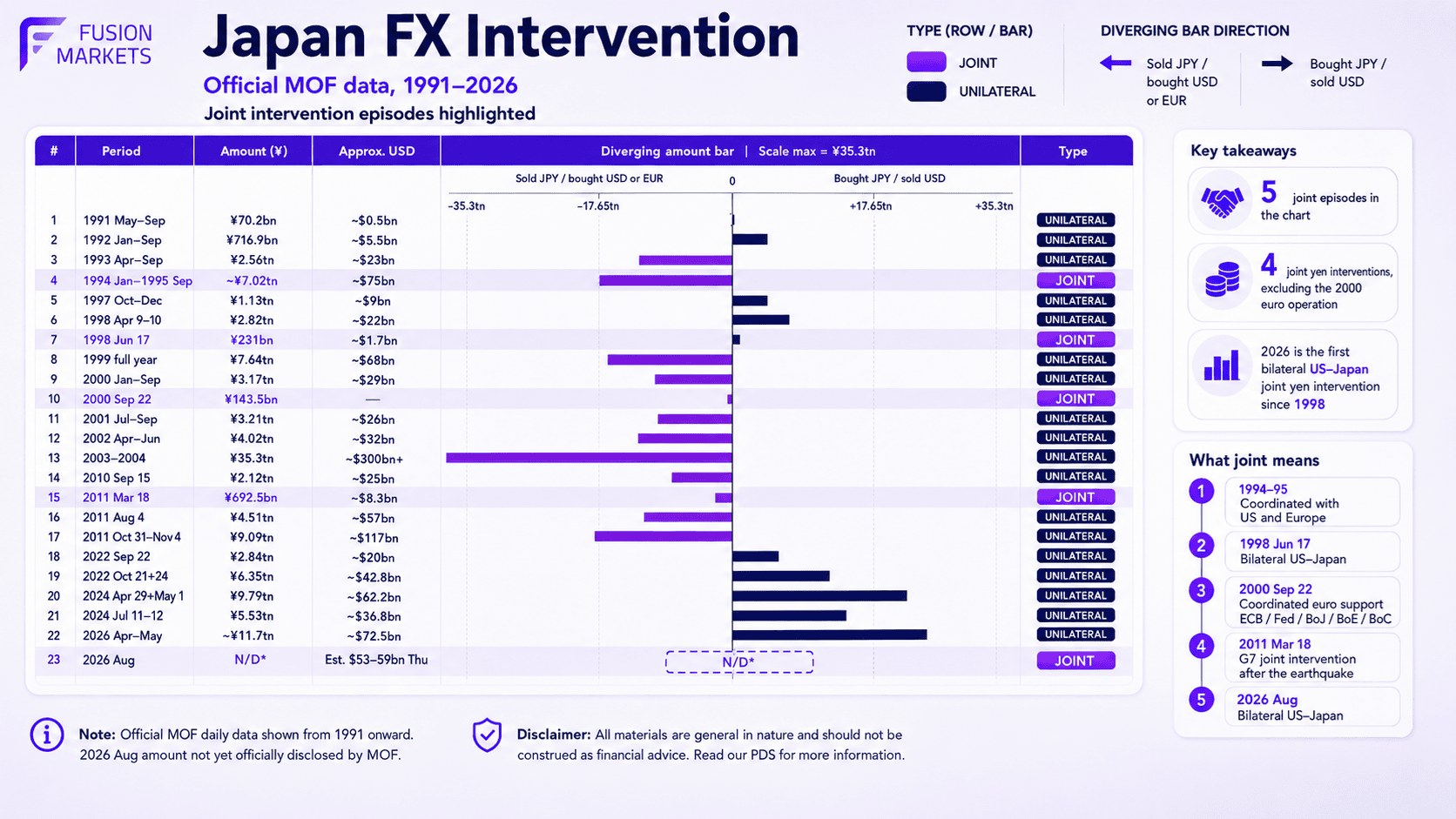
Since 1991, Japan has only been involved in four joint FX interventions.
- In 1994-95 there was coordinated intervention with the US and Europe.
- 1998 was bilateral intervention with the US
- 2000 saw coordinated intervention to support the EUR from multiple countries
- 2011 saw G7 joint intervention following the earthquake in Japan
So, the joint intervention between the US and Japan in July 2026, was the first bilateral intervention between the two countries in 26 years.
The Yen’s rapid decline has been a thorn in Japan’s side for the past couple of years.
However, the recent geopolitical developments, which have seen sharp increases in oil prices, were likely a trigger.
Japan is a net-energy importer, which means a weak currency raises the cost of importing goods.
Higher energy prices raise Japan’s import bills, putting more strain on the economy and consumers.
This was very likely one of the main reasons to take things more seriously.
For the US, the reasons to get involved were a little different. Japan is one of the largest foreign holders of US Treasuries.
The US didn’t want Japan to have to sell Treasury holdings to fund repeated intervention.
Doing so could push US yields higher, even as they are already trading at multi-decade highs.
There are also some systemic risks to consider that might have motivated both countries.
A disorderly devaluation of the Yen, for example, could have massive repercussions across global markets.
In other words, both countries had their own reasons for conducting a joint intervention to curb the Yen’s weakness.
1. US involvement is taken more seriously
Firstly, the size of the intervention was huge, but the involvement from the US changes things.
When Japan acts alone, markets can estimate the available reserves and gauge the political tolerance, which usually means it’s not sustainable.
With US involvement, markets don’t really know the potential size and duration that a coordinated effort might entail.
Markets were happy to ‘fight’ Japan when they went at it alone but might be more reluctant to test both nations when they have clearly signalled that the move has gone far enough.
2. The funding vehicle has changed
Secondly, the funding mechanism makes repeated attempts more credible this time around.
Japan reported that they will now be able to use the Fed’s FIMA (Foreign International Monetary Authorities Repo Facility) for future intervention operations.
This allows Japan to put up their Treasury holding as collateral to get access to Dollar without having to sell their Treasuries.
That gives Japan access to Dollars for intervention without risking issues in the bond market.
3. The communication strategy has changed
It seems like Japan has learned from their previous intervention mistakes.
It’s always been amusing for markets to see Japanese officials treat intervention will so much cloak and dagger by not wanting to confirm whether they intervened.
That was always silly because markets knew it was intervention by the sheer size of the moves. Also, Japan releases their official data which confirmed they intervened.
This time they didn’t shy away and confirmed almost immediately that they intervened and warned that their operation was not done and will repeat it if they have to.
The more interesting communication shift is jawboning from US officials.
Above is a Reuters photograph where Treasury Secretary Scott Bessent showed a notepad in front of him with a to do item called ‘Buy Japanese Yen (JPY) $5-10 bil’.
One has to assume this was done deliberately, especially after Bessent also mentioned that the Yen is very undervalued and warned that they won’t hesitate to intervene again.
4. The communication strategy has changed
Interventions like these are more effective when positioning is vulnerable.
Just ahead of the intervention episode, speculators were sitting on very crowded net-short positioning against the Japanese Yen.
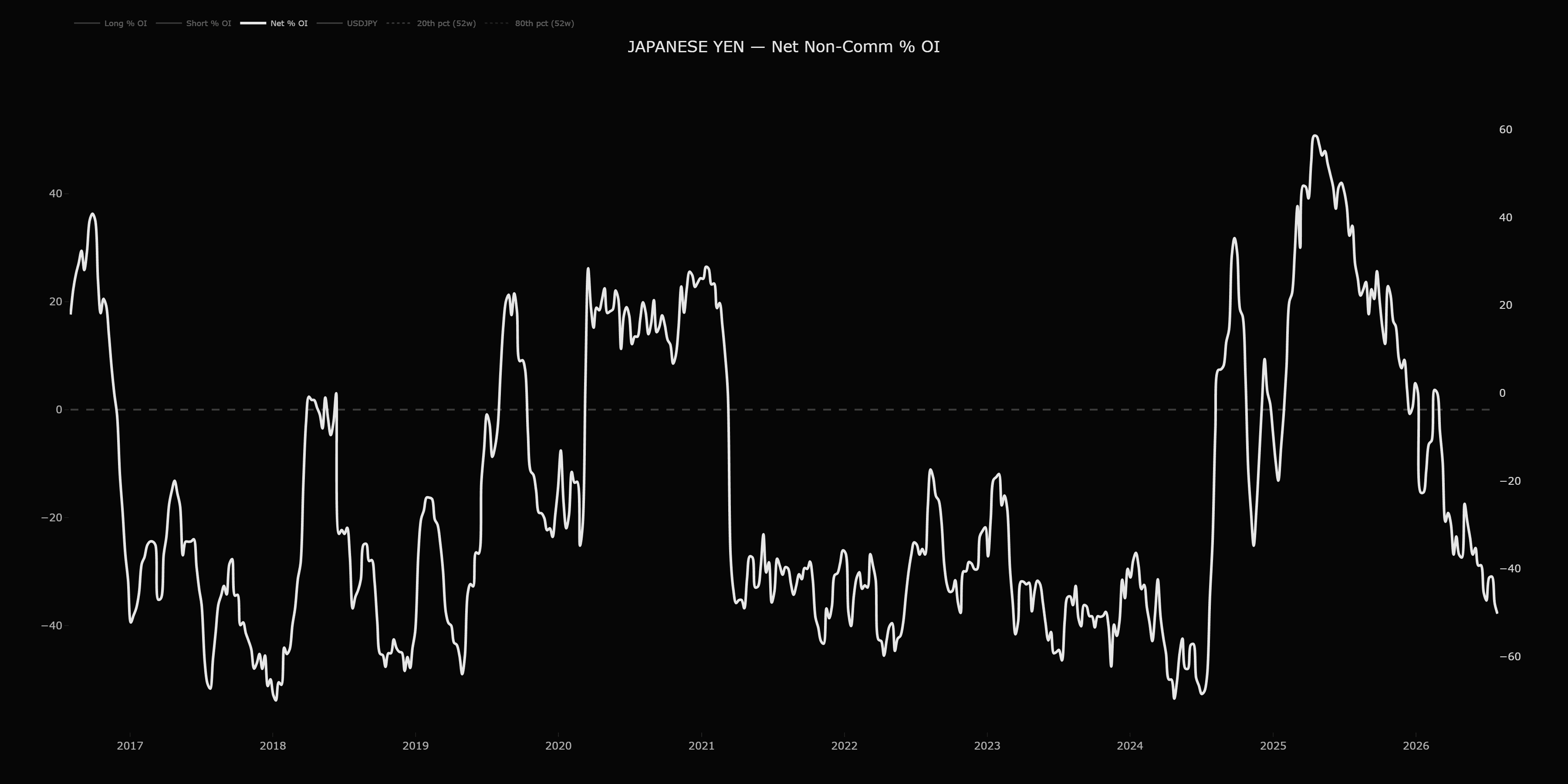
When markets are this stretched, the intervention can be magnified as traders are forced to close out crowded positions.
That means the size of appreciation doesn’t have to be exceptionally large as traders being stopped out and trimming exposure does a lot of the heavy lifting.
What the joint US-Japan Intervention has not changed?
The fundamentals.
Even though this intervention is a lot more serious than most realized, it still does not change the fundamental reasons for why the Yen was weak.
The underlying weakness is driven by the rate differential between the US and Japan, which won’t go away just because of FX intervention.
Also, the BoJ has made so many empty promises of higher rates that their continued talk of tighter policy is not an effective tool for closing the rate expectations gap.
Even though the door for higher rates in Japan remains open, the current government’s persistent budget deficits and fiscal expansion policy make higher rates seem like a pipe dream.
For a sustainable fundamental shift it would require rate differentials to narrow, or at a minimum would require rate expectations to expect interest rate cuts from the Fed.
US-Japan Joint intervention changes the risk-to-reward?
For a very long time, USDJPY carry traders were able to have their cake and eat it.
They got paid a positive carry for holding USDJPY longs, and they were also rewarded with pair appreciating in value.
This means just buying the dip isn’t as straightforward anymore.
Traders will now have to account for sudden multi-figure declines, and the potential for repeated interventions.
In other words, joint intervention means the risk to reward has changed.
Even though things like entry level and position sizing always matter, they matter even more now.
Previous intervention episodes often created buying opportunities for USDJPY once the initial shock had passed.
This time, authorities have made it clear that intervention may happen more than once.
That opens the risk that a pure carry trade strategy could face severe drawdowns before the macro view has time to play out.
For short-term traders, USDJPY is likely to become a more two-way market in the short-term.
The long side can still work when US data is firm, and Treasury yields are rising.
However, the risk here is that any meaningful or disorderly upside could be met with fresh intervention attempts to flush out speculators.
The short side can become more attractive when US data is ugly as it forces US yields lower.
On this side, it’s important to remember that Japan has previously used USD weakness as a trigger for intervention.
Which basically means that the joint intervention has changed the risk-to-reward by making buying USDJPY on good US data less attractive than shorting it on bad US data.
Intervention does not eliminate the fundamental case for a weaker yen.
But the USDJPY trade is no longer the same.
With the US joining the fight, with an improved funding mechanism, improved communication and less tolerance, the risk-to-reward for USDJPY has changed.
For traders, that means there is less confidence in blindly buying every dip and greater respect for data and major levels.
For investors, the key question is whether the intervention is eventually supported by lower US yields.
Without the fundamental support, the Yen’s bounce might remain tactical for now. But with it, last week’s intervention could mark the beginning of a much larger adjustment.
We’ll never share your email with third-parties. Opt-out anytime.
JPY intervention: circuit breaker not smoking gun