
Why FX Markets React Before the News Hits
Read Time: 3-4 minutes
If you’ve traded long enough, you’ve seen it.
The market starts moving – sometimes aggressively – minutes before a major data release. Then the number hits, and instead of accelerating, price stalls… or even reverses.
It feels unfair. Like someone knew something you didn’t.
But in most cases, it’s not insider trading or leaked data. It’s positioning.
Foreign exchange markets don’t react to news the way most retail traders think they do. They react to expectations. And those expectations are priced in long before the headline flashes across your screen.
- Expectations move markets, not headlines
- Positioning creates pre-release moves
- Liquidity and order flow matter
- When the number finally hits
- What this means for traders
Every major economic release comes with a forecast. Analysts submit estimates. Economists model outcomes. Banks circulate previews. Traders discuss scenarios days in advance.
By the time the official number is published, the market has already built a consensus view.
If traders expect US CPI to print hot, they’ll often start buying USD before the release. Not because the data is out – but because they want to be positioned ahead of it.
So when the number finally drops and matches expectations, there’s no new information. The move has already happened.
That’s why you sometimes see a strong directional drift into an event… followed by a muted reaction once it’s released.
For example, in Figure 1 below, AUDUSD begins trending higher ahead of the RBA rate decision. By the time the announcement is released at 4:30pm, a significant portion of the move has already occurred. The initial spike reflects confirmation rather than surprise.
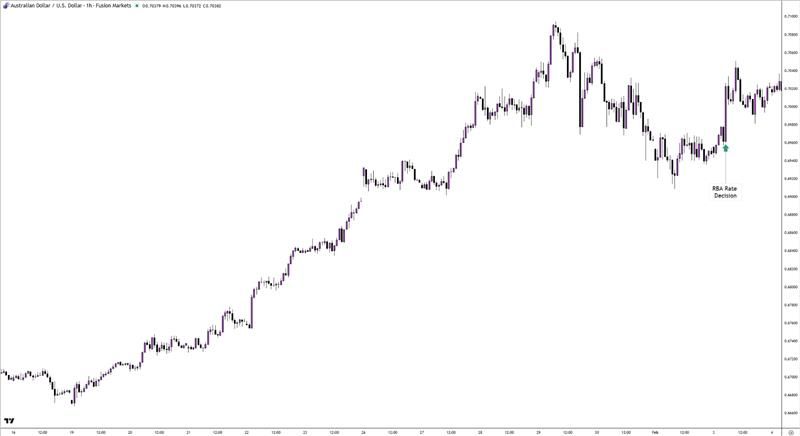
Figure 1 – AUDUSD 15-min chart ahead of RBA interest rate decision, 3rd February 2026.
The market were buying the AUDUSD in anticipation of a hike a few weeks before the actual rate decision.
Then when the decision took place, the market had a small initial reaction but the strength faded quickly as the outcome was already priced in.
FX is a forward-looking market. Large participants – macro funds, asset managers, corporate hedgers – don’t wait for confirmation. They trade probabilities.
If sentiment shifts during the week leading into payrolls, you’ll often see the move begin well before Friday.
This is especially true when:
- The prior data trend is strong
- Central bank guidance is clear
- There’s heavy consensus in one direction
- Risk sentiment is already aligned
In those cases, the release becomes less of a catalyst and more of a validation.
And when everyone is already leaning the same way, there’s often no one left to push price further once the number confirms the bias.
That’s when you get the classic “buy the rumour, sell the fact” reaction.
Another reason FX appears to move before news is liquidity behaviour.
Ahead of high-impact releases, market makers and liquidity providers often adjust quotes. Spreads can widen. Depth thins out. Larger orders can move price more easily.
If a sizeable player needs to rebalance exposure before the event, that order flow can shift price without any new data being released.
To the retail trader watching a 1-minute chart, it looks like the market “knew”.
In reality, it’s positioning and risk management happening in advance.
The key moment is not the release itself, but the comparison between:
- The actual result
- The market’s expectation
- The existing positioning
If the data beats expectations but everyone was already long, the reaction may be limited. If the number surprises significantly relative to positioning, that’s when volatility expands.
That’s why the same CPI print can trigger a 20-pip move one month and a 120-pip move the next. It’s not just the number – it’s how crowded the trade was beforehand.
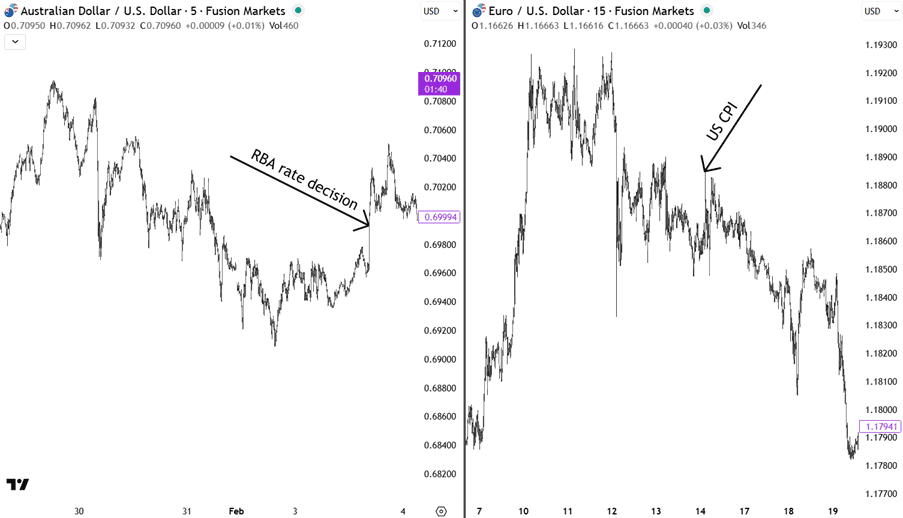
Figure 2: Priced-in reaction versus surprise repricing. Left: AUDUSD around an RBA decision with limited follow-through. Right: EURUSD following US CPI with sharp downside expansion.
Figure 2 above is an example of this.
We know the AUDUSD were trending higher for weeks, in anticipation of a hike form the RBA. Positioning was leaning in one direction, expectations were broadly aligned, and then the announcement hit, price reaction, but with limited follow through. The move lacked urgency because by the time of the announcement, the outcome was already priced in.
On the right, EURUSD into US CPI tells a different story. The pair was not aggressively trending in the immediate lead-up. When inflation printed stronger than expected, price didn’t merely tick lower – it expanded. The cluster of large candles reflects genuine repricing rather than confirmation of an already crowded trade.
The difference between the two isn’t the event category. Both are major macro releases. The difference is positioning. In one case, the market was leaning. In the other, it had to adjust. That adjustment is where volatility lives, and understanding that difference changes how you trade events.
Instead of asking, “Is the data good or bad?”
You start asking, “What is already priced in?”
If you chase every spike at release time, you’re often trading the most expensive moment in the sequence. The cleaner move frequently happens in the lead-up – when expectations are forming and positioning is building.
That doesn’t mean you should blindly enter before every release. It means you should monitor:
- Trend direction into the event
- Momentum shifts
- Volume changes
- How price behaves relative to consensus
If the market has already run hard in one direction and the data merely confirms it, the risk may actually lie in continuation – not the breakout.
Markets don’t wait for certainty. They trade probabilities.
And by the time the certainty arrives, the opportunity is often smaller than it looks.
We’ll never share your email with third-parties. Opt-out anytime.
Relevant articles